

Insights
An agent can draft a court filing. Who decides it gets filed?
It is 11 p.m. and a motion is due at midnight. The litigation team's drafting agent has done its part. It pulled the relevant authority, wrote the brief, checked each citation against the reporter, and formatted the document to the court's local rules. The only step left is the filing screen.
The agent is good at everything it has done so far. The question this article is about is narrower: who decides the motion gets filed?
The example is illustrative. The question is not. Firms are putting agents into legal work now. The legal AI vendor Harvey announced more than 500 prebuilt legal agents on May 5, 2026. As those agents connect to the systems a matter runs on, the step from draft to docket gets shorter. Our view is that it should not get shorter by default.
What the court record shows
This is already a problem in court. Damien Charlotin's AI Hallucination Cases database counted 2,262 decisions as of November 2, 2026 in which a court or tribunal found or implied that a party relied on hallucinated content. In 897 of them, the party using AI was a lawyer.
In the cases below, the sanction did not depend on who wrote the draft. It depended on who signed and filed it.
- Wadsworth v. Walmart (D. Wyo., February 24, 2025). One Morgan & Morgan lawyer drafted a motion using an AI tool that invented cases. Two other lawyers signed it. According to Bloomberg Law, neither signer helped write the motion and there was no sign either saw it before filing. The court found all three violated Rule 11. The drafter was fined $3,000 and lost his pro hac vice admission. Each signer was fined $1,000.
- Johnson v. Dunn (N.D. Ala., July 23, 2025). Butler Snow had an AI policy since June 2023 requiring approval and independent verification. Fabricated citations still reached the court. Three lawyers were publicly reprimanded, removed from the case and referred to the state bar, according to EDRM's summary. One was the practice group leader, who signed one motion without reviewing it. The court said lawyers are responsible for what they sign "regardless of who added the content." The firm itself was not sanctioned, and the court credited its policies.
Both cases involve AI tools producing drafts, not agents with access to the filing system. That is the point. Even when a person still had to file the paper themselves, the check at the signature failed. Our view is that an agent that can also do that last step removes the one moment where a person was forced to touch the paper.
What the rules already say
None of this needs new law. The rules on filing were written around a signature, and the signature belongs to a lawyer.
The signature is the lawyer's certification. Under Federal Rule of Civil Procedure 11, every pleading, written motion and other paper "must be signed by at least one attorney of record in the attorney's name." By presenting it to the court, the lawyer certifies that its legal contentions are warranted by existing law, based on "an inquiry reasonable under the circumstances." The rule also says a law firm must, absent exceptional circumstances, be held jointly responsible for a violation by its partner, associate or employee.
In e-filing, the login is the signature. Federal courts take electronic filings through CM/ECF, and the local rules we checked tie the filing account to the lawyer who registered it. The Northern District of Florida's rule, for example, says that use of the filing user's login and password "is the legal equivalent of the Filing User's original signature," whether the filer or an authorized person uses them. The Northern District of California states that only attorneys and pro se litigants may e-file. In our reading, an agent that submits a filing with a lawyer's credentials signs as that lawyer.
The ethics rules put supervision on the firm. ABA Formal Opinion 512, issued July 29, 2024, applies the Model Rules to generative AI. As summarized in Business Law Today, it says lawyers must review AI output, including citations, before submitting it to a court, under the rules on meritorious claims and candor to the tribunal. Under Rule 5.1, partners and managers must set clear policies on permitted use. Under Rule 5.3, supervising lawyers must make sure the nonlawyers they work with are trained to use it properly.
Read together, in our view, the rules draw a clear line. Anyone, or anything, can help prepare a filing. Only a lawyer of record can sign it.
Drafting and filing are different decisions
Research, drafting and cite-checking all produce work product. A lawyer can read it, change it or throw it away, and nothing has happened outside the firm. Filing is different in three ways.
- It is the signature. In e-filing, submitting under a lawyer's login is that lawyer's signature, with the Rule 11 certification that comes with it.
- It is public and it stays. A filed paper lands on the docket. A mistake is fixed with another filing, not an undo.
- It speaks for the client. What a filing says about the facts and the law can bind the party it is filed for.
So the line in this article is not between good agents and bad agents. It is between two kinds of decision. A drafting agent may research, draft and check citations within its mandate. Filing is not in that mandate. When the agent reaches the filing step, the action escalates to the supervising attorney.
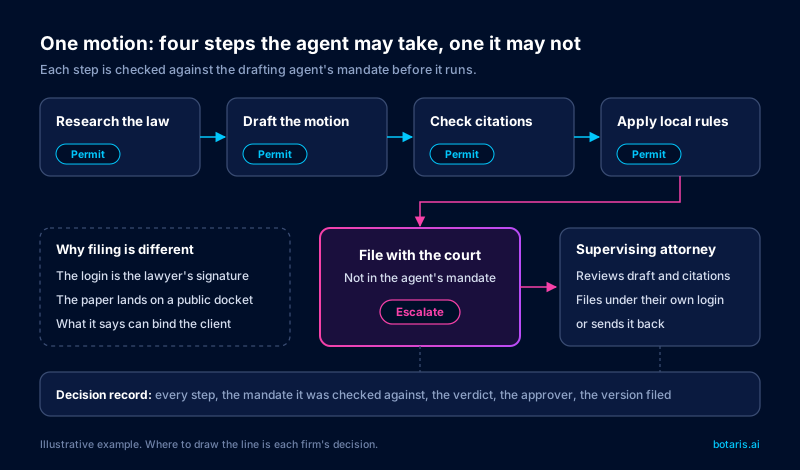
The agent does the work up to the filing screen. The lawyer whose name goes on the paper decides whether it goes.
This is our position, not a rule any court has written for agents. A firm could draw the line elsewhere. What matters is that someone draws it on purpose, before the agent runs, rather than finding out where it was after a sanctions hearing.
What escalation to the supervising attorney looks like
Escalation is only useful if it puts the right things in front of the right person in time. In our view, a filing escalation should carry:
- The final draft, with what changed since a lawyer last reviewed it.
- The citation check, showing which authorities were confirmed against what source and which were not.
- The deadline, so the request is ranked by when the paper is due, not when it arrived.
- The mandate, so the attorney can see what the agent was and was not allowed to do on this matter.
The attorney then does one of two things. They file it under their own login, or they send it back with a reason. Either way, the record shows who decided, when, and which version reached the court.
Two details decide whether this works at 11 p.m. The first is who receives the escalation. It should go to the supervising attorney named on the matter, with a named backup, never back to the agent or to an empty queue. The second is that the agent cannot route around it. If the same agent holds a lawyer's e-filing login, the escalation is a suggestion. The check has to sit in the path of the action, so that the filing step does not run until the approval exists.
In our reading, that is the lesson of Johnson v. Dunn. Butler Snow had a written policy requiring approval and verification, and the court credited it. It did not stop the filing. A policy tells people what to do. A check in the action path decides what can happen.
Where BotAris fits
BotAris governs the decision, not the draft. People define each agent's mandate in the Authority Model as policy they own, with a named grantor. For a drafting agent, that mandate can grant research, drafting and citation checks on a matter and leave filing out. The enforcement point checks each action in the action path and resolves it to permit, escalate to a person, deny, or permit and flag for audit. Filing resolves to escalate, routed to the supervising attorney. The Accountability Ledger records the mandate, the verdict, the approver and the version filed, at the moment of the decision.
BotAris does not check citations, judge the quality of a brief, or replace a lawyer's review. It makes sure the review happens before the filing, and that there is a record of who decided.
The question for every firm
Filing is the clearest case because the rules already tie it to a signature. It is not the only one. Our own starting list of steps that should stay with a lawyer would include agreeing to a stipulation with opposing counsel, telling a client what to do about a settlement offer, and deciding to produce a document that might be privileged. Every practice will have its own.
As agents take on more of the work, the decisions that carry a lawyer's name should not move with it by default.
So here is the question we would put to every litigation and practice group leader: which steps in a matter should never leave a lawyer's hands?
Sources. Damien Charlotin, AI Hallucination Cases database, last updated November 2, 2026. Bloomberg Law, Morgan & Morgan Lawyers Fined for 'Hallucinated' AI Citations, February 2025, on Wadsworth v. Walmart Inc., No. 2:23-cv-118 (D. Wyo.). EDRM, When AI Policies Fail: The AI Sanctions in Johnson v. Dunn, July 2025. Federal Rule of Civil Procedure 11, via Cornell Legal Information Institute. U.S. District Court, Northern District of Florida, What constitutes an electronic signature? U.S. District Court, Northern District of California, Only attorneys and pro se litigants may e-file. Business Law Today, ABA Ethics Opinion on Generative AI Offers Useful Framework, October 2024, on ABA Formal Opinion 512 (July 29, 2024). Harvey, Harvey Launches Purpose-Built Legal Agents Across Every Major Practice Area, press release, May 5, 2026. The opening scenario is illustrative. The line between drafting and filing, and the escalation design, are our position, not a court rule or bar guidance.
Give every agent a mandate, not just a credential.
More from BotAris
Mapping NYDFS Part 500 to AI agent governance
Part 500 never mentions AI agents. In our reading it already reaches the accounts they run on, the transactions they start, and the activity they produce. Six sections, what each one requires, and the evidence that answers it.
Your AI agent inherited your permissions. That is the problem.
The fastest way to deploy an agent is to hand it a person's access. Twenty years of identity data say that access was never right to begin with.
Who answers for the agent?
Three months of lab disclosures ended the same way every time: someone took responsibility afterward. Accountability has to exist before the agent acts.